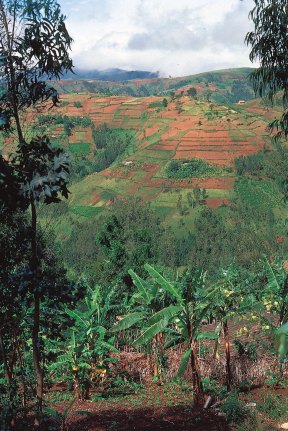
 Again, my kids like the lesser known countries. So when it comes to obscure, the tiny central African country of Burundi is definitely up there.
Its about the size of Maryland but has nearly twice as many people – despite it being mostly rural. And while up-to-date statistics are hard to come by (thanks to its crazy government) it has often been listed as one of the top countries when it comes to people living in poverty. And ever since 1962, when its became independent, the country has not gone more than a few years without a civil war, coup or a new constitution.
The landscape does look beautiful – like much of central Africa – especially the pristine shores of Lake Tanganyika. But with all the conflict in that area these days, I doubt we will be traveling to Burundi anytime soon!
Background

Here is the link to our information packet on Burundi: burundi
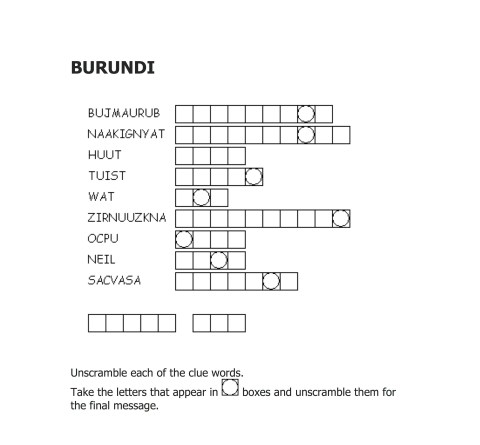
And once you/your kids are done learning about Burundi you/they can do this quick word scramble puzzle below. (Here the link to the PDF: burundi_scramble)
Some of the fascinating facts my boy enjoyed learning about Burundi are:
- The average income is just US$240 a year
- More than 50% of their exports go to the United Arab Emirates
- It has had four different constitutions in the country’s 55 year history (and its leaders often ignore them)
- It is one of the only countries in Africa defined by an ancient kingdom and not by colonial rulers
- A pygmy group called the Twa were some of the countries first inhabitants
Food
As mentioned, Burundi is a very poor country. Hence, the food is pretty simply and rarely is meat consumed. But it was interesting to try the new food and eat like a Burundian. In fact, to make the experience all that more true, Isaac insisted that we eat all our meals outside and that we should not eat lunch. (Andrew did not agree with this idea and Isaac gave into a snack at around 3pm).
Here’s our Burundian Menu. It was hard to find recipes and information on food from this country but eventually I tracked some down:

BREAKFAST:
- Porridge with Banana ( No recipe here, just used some old-fashion grits and water, mashed bananas – frozen ones actually work great – and a little brown sugar)
- Coffee – for me (one of the main crops of Burundi)
- Fresh pineapple juice – for the kids


DINNER:
- Burundi Beans and Plantains (Pretty simple. And I sped up the process by using two 15oz cans of kidney beans. I would also recommend frying the plantains separate from the onions – they do take longer.)
 Bugali (This is their version of fufu/ugali. You can buy cassava fufu any African food market but I found that the maize/corn based one tastes better.) For this you just combined equal parts water and PAN (an instant corn flour often used in Latin American food. I just found it at Giant.) Then you just dip chunks of it into the stew
- Spicy carrots. No recipe but just chopped carrots and cooked them in oil with a little salt and chili powder
Culture and Crafts
The Royal Drummers of Burundi are world famous – even listed as a World Heritage Site (although the oddly now live in Dayton, Ohio). So it was quite obvious that our activity needed to involved drumming. So we listened to the Royal Drummers. And then made some drums of our own and drummed away.


Here more info on the Royal Drummers: Daily Mail Article.
And here they are drumming, so you get an idea of the sound. (Its definitely different from the “American” drum sound.) Royal Drummers of Burundi Video
And here how we made our very simple drums:

- Find a large bucket.
- Find two stick with a wider diameter (the large the diameter the deeper the sound)
- Make a picture of the the Burundi flag and tape it to the drum
- Turn the bucket upside down and play.
Here’s our take on Burundi drumming: Boys on Drums
Thank you for joining us on our travels. Next week – Isaac said he wants it to be surprise! So guess for yourself what C will be for!


Great post! I had never even heard of Burundi before! Can’t wait to hear what C is!!
LikeLike