C is for Cambodia

rural c

For C we didn’t choose Canada or China for example because they’re both too big and well known. We didn’t pick African countries like Cameroon and Comoros because they’re too close to our last country. Instead we picked this country home to the Khmer Rouge and Angkor Wat.

With its interesting history and poor economy this mainly Buddhist country, called Cambodia, is the smallest country on the Indochina peninsula.

If you want to learn more click here for our info packet. Cambodia

For the word search click here: CambodiaWordSearch
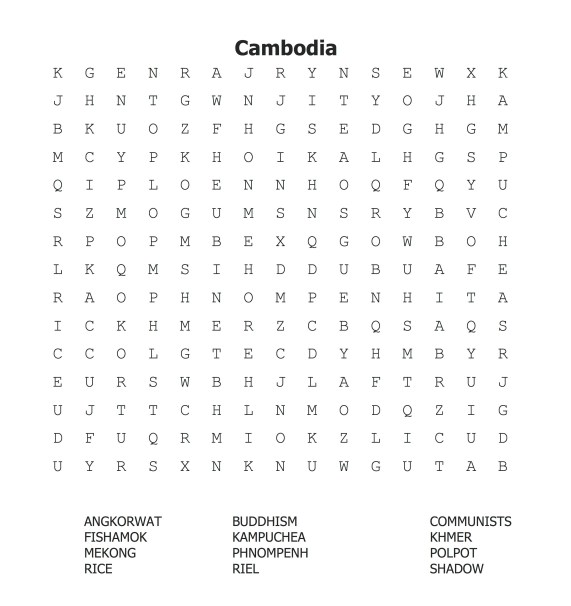
cambodiawordsearch.jpg

Interesting Facts about Cambodia:

  1. The great lake’s depth in the wet season is 9 times deeper then it is in the dry season. The area growth nearly triples it size from the dry to the wet season.
  2. The Vietnamese communists invaded the Khmer Rouge communists.
  3. The people and language are not called “Cambodians”and “Cambodian”, instead both are called Khmer.
  4. Angkor Wat is on the Cambodia flag.


Food

Food in Cambodia has Vietnamese and Thai influence. A lot of dishes have fish in them. Most dishes are not that spicy and a lot of dishes have lemongrass in them. For breakfast we had pork noodle soup (Kuy Teav). For dinner we had a green mango salad.(Swai Nhoam Pakea Kiem) and fish amok.

Breakfast

Kuy Teav recipe  For this recipe we took a shortcut and got instant pork broth and mixed it with gelatin instead of making the pork broth from scratch. It tasted like ramen noodles and the pork broth was very yummy! mmmm


IMG_5918

Dinner

Green Mango salad recipe  This tasted a lot like the Thai green papaya salad. Our mangoes were green on the outside but orange in the inside. Try to find ones that look more green on the inside.

Fish Amok recipe  This is served in a banana leaf boat. For us it was hard to wrap them so we tried two and laid the banana leaves in a pan.  We also steamed in the oven. Our Amok was not as custardy as it showed in the picture. It was more watery but still tasty.


Culture and Art

For the art we did Khmer shadow puppets which are pretty cool. A white screen is put down before a fire. The actors cast their puppets on the screen and act the play out with their puppets. They create a shadow on the screen with the puppets but the actors have to be careful not to show their body. Puppets are traditionally made with leather, but we’ll stick to black construction paper right now. Puppets characters are sacred gods. Here is a link to a video to learn more about these shadow puppets:                                                Sbek Thom Shadow Theater

  Instructions to make shadow puppet

  1. Draw a character on black paper. Make sure to have a circle outline and holes or slits inside the outline to show the character. The edges of the character have to be connected to the outline.
  2. Cut the holes out using an xacto knife. Make sure you do it on a cutting board. If you break the line tape it together.
  3. Tape some sort of long skinny thing to each side of the puppet. We used skewers.
  4. To set up the theater hang a white sheet from something. Put a light behind it. Then lay down or duck to act it out. You must hold the puppets up high.

To watch a video on our shadow puppets press here.

IMG_5999


Cambodia Flag

The Cambodia flag has 2 stripes of blue on and below a bigger stripe of red. As i’ve already explained the towers of Angkor Wat are on the front. The white color represents the country’s major religion: Buddhism. The temple represents the universe. The blue represents Cambodia’s royalty of its past empires. And lastly, the red represents means the nation, Cambodia. It was adopted on June 30, 1993, the flag was originally adopted before the Khmer Rouge on October 29, 1948. To learn more, click here on the Wikipedia description: Cambodia flag

20170824_074826_resized

Next is D is for Dominica.

– By Isaac
B is for Burundi

burundi landAgain, my kids like the lesser known countries. So when it comes to obscure, the tiny central African country of Burundi is definitely up there.
Its about the size of Maryland but has nearly twice as many people – despite it being mostly rural. And while up-to-date statistics are hard to come by (thanks to its crazy government) it has often been listed as one of the top countries when it comes to people living in poverty. And ever since 1962, when its became independent, the country has not gone more than a few years without a civil war, coup or a new constitution.

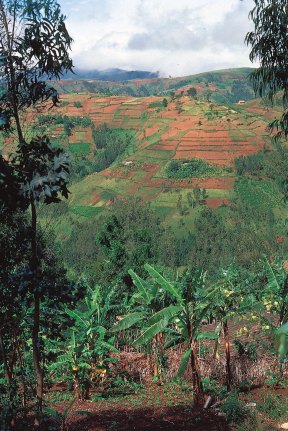
The landscape does look beautiful – like much of central Africa – especially the pristine shores of Lake Tanganyika. But with all the conflict in that area these days, I doubt we will be traveling to Burundi anytime soon!

Background

img_5741.jpg

Here is the link to our information packet on Burundi: burundi

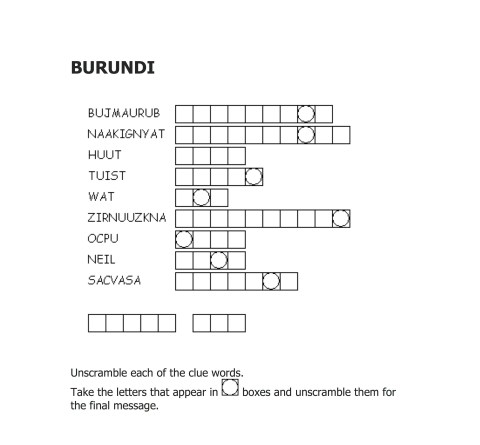
And once you/your kids are done learning about Burundi you/they can do this quick word scramble puzzle below. (Here the link to the PDF: burundi_scramble)

burundi_scramble

Some of the fascinating facts my boy enjoyed learning about Burundi are:

  • The average income is just US$240 a year
  • More than 50% of their exports go to the United Arab Emirates
  • It has had four different constitutions in the country’s 55 year history (and its leaders often ignore them)
  • It is one of the only countries in Africa defined by an ancient kingdom and not by colonial rulers
  • A pygmy group called the Twa were some of the countries first inhabitants

Food

As mentioned, Burundi is a very poor country. Hence, the food is pretty simply and rarely is meat consumed. But it was interesting to try the new food and eat like a Burundian.  In fact, to make the experience all that more true, Isaac insisted that we eat all our meals outside and that we should not eat lunch. (Andrew did not agree with this idea and Isaac gave into a snack at around 3pm).

Here’s our Burundian Menu. It was hard to find recipes and information on food from this country but eventually I tracked some down:

img_5510.jpg

BREAKFAST:

  • Porridge with Banana ( No recipe here, just used some old-fashion grits and water, mashed bananas – frozen ones actually work great – and a little brown sugar)
  • Coffee – for me (one of the main crops of Burundi)
  • Fresh pineapple juice – for the kids

DINNER:

  • Burundi Beans and Plantains (Pretty simple. And I sped up the process by using two 15oz cans of kidney beans. I would also recommend frying the plantains separate from the onions – they do take longer.)
  • img_5516.jpgBugali (This is their version of fufu/ugali. You can buy cassava fufu any African food market but I found that the maize/corn based one tastes better.) For this you just combined equal parts water and PAN (an instant corn flour often used in Latin American food. I just found it at Giant.) Then you just dip chunks of it into the stew
  • Spicy carrots. No recipe but just chopped carrots and cooked them in oil with a little salt and chili powder

Culture and Crafts

The Royal Drummers of Burundi are world famous – even listed as a World Heritage Site (although the oddly now live in Dayton, Ohio). So it was quite obvious that our activity needed to involved drumming. So we listened to the Royal Drummers. And then made some drums of our own and drummed away.

Here more info on the Royal Drummers: Daily Mail Article.

And here they are drumming, so you get an idea of the sound. (Its definitely different from the “American” drum sound.) Royal Drummers of Burundi Video

And here how we made our very simple drums:

IMG_5751

  1. Find a large bucket.
  2. Find two stick with a wider diameter (the large the diameter the deeper the sound)
  3. Make a picture of the the Burundi flag and tape it to the drum
  4. Turn the bucket upside down and play.

Here’s our take on Burundi drumming: Boys on Drums


Thank you for joining us on our travels. Next week – Isaac said he wants it to be surprise! So guess for yourself what C will be for!


A is for Albania

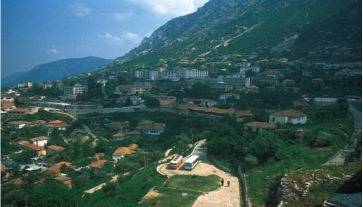
albaniatown

My boys decided they wanted to focus on the lesser known countries, so the likes of Australia or Argentina were ruled out. Eventually we put the names of about six countries starting with A (like Azerbaijan and Antigua & Barbuda) in a box and we drew out Albania!

I must say, I am now a big fan of Albania. And I really do hope to travel there one day! The food is a amazing and the landscape – beaches and mountains – look gorgeous. And as its one of the poorest countries in Europe, it’s super affordable!

Background

IMG_5199


Here is the info sheet for Albania (click on the link for a five-page – with lots of pictures -PDF): Albania.


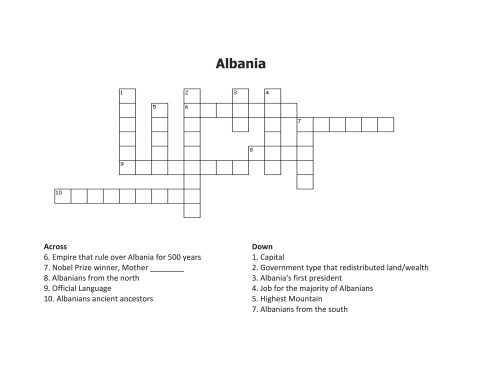
And when they are done, you/your kids can test what they learned by doing this quick crossword puzzle (PDF is in link as well). AlbaniaCW

AlbaniaCW

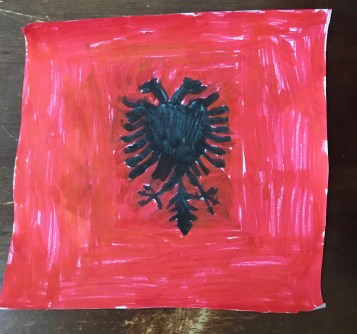
My boys also make it a point to draw the flag of each country (per the flag above). Note the prominent two headed bird, which, apparently, the tradition is that native Albanians descended from such an animal.

And some of my kids favorite facts include:

  1. Albania shares its highest peak with Macedonia
  2. The first president called himself  King Zog (hee, hee!)
  3. Albanian is a unique language – in its own language group separate from all other Indo-European languages.
  4. The rise of communism in the country made it one of the poorest nations in Europe (and made Atheism the national religion)


Food

This week I discovered how tasty Albanian food is! Its a mixture of Greek/Turkish/Eastern European culture. And it is delicious! And thankfully being of very European, most all of the ingredients can be found in at a regular grocery store.

Here’s what our meals looked like and the recipes we used to make everything. This was definitely Isaac’s favorite part about Albania week!


DINNER

  1. Albania’s national dish Tave Kosi  (This is very clear recipe to follow. We did end up cooking it for about 20 minutes longer and it turned out great! Though, you might want to add another 1/4 cup rice. Also we used veal instead of lamb (due to my aversion to it), and it worked well with the precooking of the meat cut back to 30 minutes.)
  2. Byrek me Spinaq (Kind of like spanakopita and quite easy to make! We did use only one-third of spinach called for and a lot more feta)
  3. Kulac Albanian Soda Bread (Another simple, kid-friendly recipe to make! We did bake it a lot less than the recipe says, so keep your eyes on the bread!)
  4. Greek/Albanian Salad. No recipe here basically combination of chunks of cucumbers, green peppers, tomatoes, and feta cheese, and onion slivers and a little oregano, olive oil and salt. Prepare it with more or less of whatever ingredient depending on what you like best!


BREAKFAST

  1. Yogurt and honey. (What we have for breakfast many mornings, so that was easy!)
  2. Shendetlie (This recipe is all in metric measurements but it pretty easy to convert knowing that 200g of sugar/flour about 1 cup.) Its technically a dessert but we decided it could pass a breakfast
  3. Left over Kulac front the night before and jam.


Culture and Craft

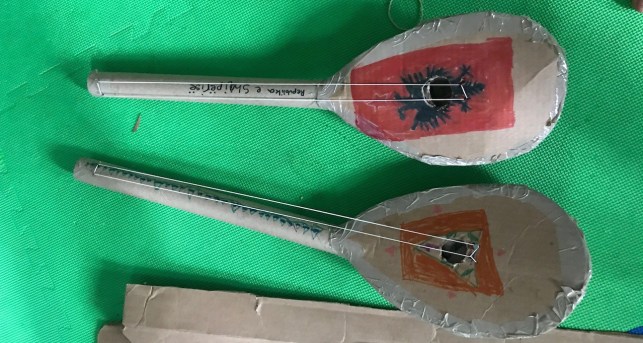
After doing some research online, it seems that Albanians are quite proud of their musical heritage (more so than, say, art or dance), specifically, all the instruments that are specific to the Albanian area. So we decided to listen to some music on the two-stringed Albanian Cefteli – Cefteli Music Cefteli Music – and then make some and play for ourselves. Andrew loved this best.

img_5173.jpg

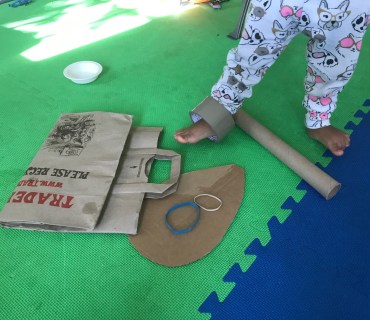
All you need is:

  1. Piece of cardboard
  2. Brown paper bag
  3. Cardboard tube (I find half of a wrapping paper roll works best as its firmer. But a paper towel roll will do!
  4. Packing tape (preferably brown)
  5. Two extra long rubber bands (we actually used longer ones than pictures here)
  6. Four small nails with larger heads
  7. Crayons/markers/paint

CARDBOARD CEFTELI (By Isaac)

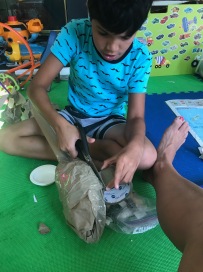
  1.   Cut out a raindrop shape (with its point not there) out of the cardboard box that is about 10 to 11 inches tall. Then cut a small hole in the center of the raindrop.
  2. Take a brown paper grocery bag, turn it inside – out (so you don’t se the labels),then mold it into the shape of the raindrop.
  3. Tape the paper bag to the edge of the raindrop with brown packing tape.
  4. Put a cardboard tube that is about a foot long and stick it at the top of the raindrop where the point of the raindrop would be, between the bag and the raindrop. Then tape it the the raindrop and bag.
  5. Tape the back of the paper bag starting and ending on the edge of the raindrop in a straight line. Do this until the tape has covered all of the paper bag. Push down on the hole so it is clear. IMG_5177
  6. Color the raindrop. You can use the Albania flag or other cool and crazy designs.
  7. Put two tiny nails in, a little bit lower than the hole. Put two other nails, towards the top.
  8. Then attach a rubber band to two of the nails on opposite sides. Connect to the other nails.
  9. You play this cefteli like a guitar. Adjust the bottom nails to how high or low you want the strings sound to be.

Here’s the boys in action. Actually sounds pretty neat!: Cardboard Cefteli Playing

img_5197-1.jpg

Thanks for joining us on our playroom tour of Albania! Next week: B is for Burundi.

Helpful links on your travels

Welcome to Playroom Passports!

Each week we hope to post new information and recipes on a different country. We are starting by working our way through the alphabet – A to Z.

In addition to the info we provide, you can also visit these helpful and fun links to further your knowledge about each country.

I will be updating this on an ongoing basis – and please share your ideas. So keep checking back.

Enjoy!

Britannica Kids – Where I copy/pull most of the information for the country info sheets. The great part about it is that there are three different levels of info for each topic (elementary, middle school, high school). So if the info I provide is to complicated or basic (I usually edit down the middle version) you can go there and find a simpler/harder version. There is free trial, but you eventually you do have to pay. We find it worth it!

If It Were My Home – My boys love this site! You just click on a country and find out how the United States – or any country –  compares to another in terms of income, education, life expectancy, etc. Fascinating stuff, especially after looking at a few together!

Google Translate – Every time we learn a country we translate whatever is on our mind into that countries language(s). Even better when that language has the voice option, so we can hear how things are pronounced. And choose a phrase (we like to use “I love you”) and translate it each week and keep track of each one!

How to Draw Flags App – This is only an app (for Android), not a website. But Isaac insisted that we include it on this list as he and Andrew love to draw flags. And this free app gives step-by-step instructions on a grid.

Discovery Puzzle Maker – Not a geography site, but where I make all the crosswords, word searches and puzzles. Its completely free! So feel free to make more and/or different puzzles if you want!